
How we test
Window testing for the US, start to finish.
Every system is tested for air, water and structural load. Impact systems also pass missile impact and cyclic pressure.
See the tests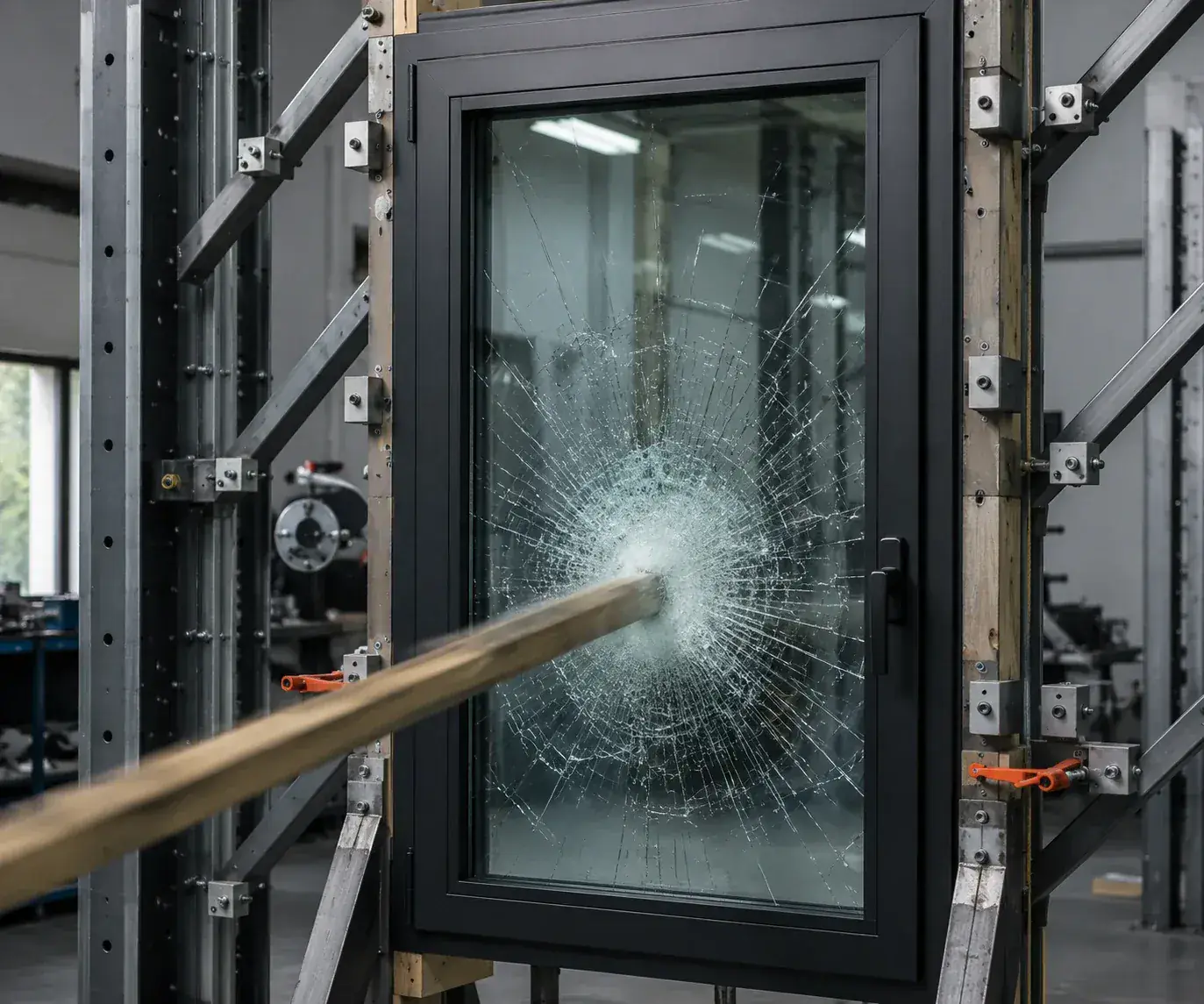
Impact and non-impact
Two kinds of system, one test program.
VALDA offers both. Our systems are AAMA tested and Florida approved.
Non-impact systems
Rated to AAMA/NAFS
Tested for air, water and structural load.
Impact systems
Plus Florida Product Approval
Plus missile impact and cyclic pressure.
Non-impact systems. For projects outside wind-borne debris regions, or where an approved shutter or covering protects the opening. They are tested for air, water and structural load and carry an AAMA/NAFS performance class and grade.
Impact systems. Everything a non-impact system goes through, plus missile impact and cyclic pressure. They also carry a Florida Product Approval that fixes the sizes, design pressure and installation.
The tests
/01
What each test does.
Every system, every time.
Impact or not, every window and door is tested for air, water and structural load. It shows how it behaves on an ordinary windy, rainy day.
Impact or not, a window or door for the US market is rated to the North American Fenestration Standard, AAMA/WDMA/CSA 101/I.S.2/A440 (NAFS). These tests tell you how it behaves on an ordinary windy, rainy day.
The window is sealed onto a pressure chamber, and the chamber changes the air pressure behind it while the lab measures leakage, sprays water and loads the glass. In the HVHZ, TAS 202 covers the same ground.
Air
ASTM E283Measures how much air leaks through the joints at 1.57 psf, roughly a 25 mph wind.
Water
ASTM E547 / E331Water is sprayed on the outside at 5 US gallons per square foot per hour while the chamber pulls air. The rating is the highest pressure with no water getting in.
Structural
ASTM E330Loaded in both directions to the design pressure, then to 150% of it. Nothing may break, and only a small permanent bend is allowed.
The rating
NAFSThe results add up to a performance class and grade, such as CW-PG65: a commercial window rated for ±65 psf. The rating for each configuration is on its approved drawing.
How much heat gets through.
Energy codes ask how well a window keeps heat in, and the sun's heat out. NFRC rated, data on request.
Energy codes ask how well a window keeps heat in, and the sun's heat out. In the US, those numbers are rated under procedures set by the National Fenestration Rating Council (NFRC).
The whole window is mounted between a warm chamber and a cold one in a calibrated hot box, and the lab measures the heat it takes to keep the warm side steady. Computer simulation covers the other sizes and glass options, and an independent inspection agency checks the results before a rating is issued and printed on the label.
U-factor
NFRC 100How much heat passes through the whole window: glass, frame and edges together. The lower the number, the better it insulates.
Solar heat gain
NFRC 200 · SHGCThe share of the sun's heat that ends up inside, from 0 to 1. Lower keeps a building cooler in hot climates.
Visible transmittance
NFRC 200 · VTThe share of visible daylight that comes through, from 0 to 1. Higher means brighter rooms.
Condensation resistance
NFRC 500How well the inside surfaces resist condensation on a cold day, on a scale of 1 to 100. Higher is better.
VALDA systems are NFRC tested and rated. Thermal values depend on the frame, the glass build-up and the size, so ratings are available for each system on request.
For impact-rated systems.
An air cannon fires a timber 2x4 at the glass. Impact glass is laminated, so it can crack while the opening stays closed.
Where wind-borne debris protection is required, an impact system goes further. It follows ASTM E1886 and E1996, and TAS 201 and TAS 203 in the High Velocity Hurricane Zone (HVHZ).
The window is built exactly as it will be sold, anchored into a test buck, and an air cannon fires a timber 2x4 at the glass. Three identical specimens are tested. Impact glass is laminated, so it can crack while the opening stays closed.
Annealed glass
Ordinary float glass. It breaks into large, sharp pieces that fall out of the frame.
Tempered glass
Heat-treated and about four times stronger. It breaks into small granules, but once it breaks the opening is empty.
Laminated glass
Two lites bonded to a tough PVB or ionoplast interlayer. It can crack, but the pieces stay stuck to the interlayer and the opening stays closed.
Missile impact
A large missile for glazing near the ground, small steel balls for glazing higher up.
- Large missile
- A 9 lb timber 2x4 at 50 ft/s, about 34 mph
- Where it hits
- Near the center of the glass and near a corner
- Small missile
- 2 g steel balls at 130 ft/s, for glazing more than 30 ft above ground
- To pass
- No penetration. Then straight on to the pressure cycles
Then 9,000 pressure cycles.
A storm does not push once. It gusts for hours, so the cracked specimen goes straight onto a pressure chamber.
A storm does not push once. It gusts for hours. So the same cracked specimen goes onto a pressure chamber: 4,500 cycles push inward, building up to the full test pressure, then 4,500 cycles of suction ease off from it. It passes only if the glass stays in the frame, with no tear longer than 5 in and no opening a 3 in ball could pass through.
Locked means locked.
Where a code or a project calls for it, the lab tests how well the locks, sash and glazing hold against someone trying to get in.
Where a code or a project calls for it, windows and doors are tested for forced entry: how well the locks, sash and glazing hold against someone trying to get in from outside.
With the unit closed and locked, the lab tries to manipulate the locks, holds loads at the locking points and the sash, and works hand tools into the joints for a set time. To pass, it must stay locked and closed, with no way in.
- Windows
- AAMA 1302.5 or ASTM F588
- Sliding doors
- ASTM F842
- Swinging doors
- ASTM F476
- In the HVHZ
- Part of TAS 202
Which standard covers what
Windows and doors for the US market are tested against the North American Fenestration Standard, AAMA/WDMA/CSA 101/I.S.2/A440, for air, water and structural load. Impact-rated systems also pass missile impact and cyclic pressure: ASTM E1886 and E1996, and TAS 201, 202 and 203 in the High Velocity Hurricane Zone. Thermal performance is tested and rated under NFRC procedures, and forced entry is tested where it applies.
We sell impact and non-impact systems, so we test for everything: AAMA/NAFS, NFRC, impact and forced entry. Here is what each test does, and which systems it applies to.
| Test | Standard | Applies to |
|---|---|---|
| Air leakage | ASTM E283 | All systems |
| Water penetration | ASTM E547 / E331 | All systems |
| Structural load | ASTM E330 | All systems |
| Performance class and grade | AAMA/WDMA/CSA 101/I.S.2/A440 (NAFS) | All systems |
| U-factor, SHGC, VT | NFRC 100 / 200 | All systems |
| Condensation resistance | NFRC 500 | All systems |
| Missile impact | ASTM E1886 / E1996 | Impact systems |
| Cyclic pressure | ASTM E1886 / E1996 | Impact systems |
| Impact and cycling in the HVHZ | TAS 201 / TAS 203 | Impact systems approved for the HVHZ |
| Air, water and structural in the HVHZ | TAS 202 | Systems approved for the HVHZ |
| Forced entry, windows | AAMA 1302.5 / ASTM F588 | Windows, where required |
| Forced entry, doors | ASTM F842 (sliding) / ASTM F476 (swinging) | Doors, where required |
Approval
/02
From test rig to your wall.
Passing the tests is only the start. This is how a result becomes a rating and an approval you can build with.
- /01
Independent lab
An accredited, independent lab tests full-size specimens: air, water and structural load, plus impact and cycling for impact systems.
- /02
Test report
The lab issues a signed report describing exactly what was tested: sizes, glass, anchors and results.
- /03
Evaluation
An evaluation entity or Florida-registered engineer checks the reports against the Florida Building Code.
- /04
Approval
Every system gets its AAMA/NAFS rating. Impact systems also get a Florida Product Approval (an FL number), which fixes the maximum size, the design pressure and the installation drawings.
- /05
Factory audits
A third-party quality assurance agency audits the factory, so every unit matches the one that was tested.
- /06
On site
Each unit is labeled and installed to the approved drawings, and the building inspector checks it against the approval.
/03
Test reports and approvals on request.
Tell us about your project and we will send the ratings, approvals, test reports and installation drawings for the systems you are looking at.